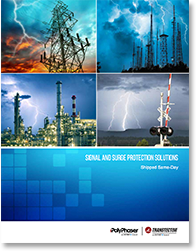
Surge protection is essential to any application that includes sensitive electronics and mission-critical communications. Estimates place the cost of network downtime at about $5,600 per minute, not to mention the frustration of downed service and the potential for necessary repairs.
Surges Explained
Briefly, a surge is a spike or other disturbance—in other words, a transient wave—of current, voltage, or power that can disrupt, damage, or degrade electronic equipment and interrupt, delay, and corrupt signal transmissions.
Transient disturbances on a power waveform can reach amplitudes of tens of thousands of volts. Manufacturers and network operators are particularly vulnerable to equipment damage during lightning strikes, outages, and other events.
Equipment Standards
In general, electrical equipment functions at a specific nominal voltage (e.g., 120 Vac, 240 Vac, etc.), with the ability to handle minor variations in standard operating voltage. However, surges pack potential damage to virtually all equipment, impacting network operability.
Surge Protection
Surge protection devices (SPDs) eliminate events outside nominal levels, reacting in nanoseconds to protect vital equipment. (Comparatively, circuit breakers and fuses typically react in seconds.) The quick response and reliable protection of simple SPDs can be the difference-maker in maintaining network operability and, ultimately, revenue.
PolyPhaser and Transtector provide high-quality RF, AC, DC, EMP, and data signal surge protection solutions and enclosures for mission-critical communications worldwide. You gain decades of experience, patented technology, and reliable products delivered with same-day shipping.
Learn more here:
Surge Protection Brochure | NEMA Surge Protection Institute: “What are Surges”