The Hidden Risk in RF Systems: Why Surge Protection is Non-negotiable
RF system failures often seem sudden and unexplained. In reality, they are rarely due to hardware flaws. Instead, the true culprits are usually invisible forces—lightning strikes and power transients—that slowly degrade performance over time. A system may appear to function normally after a storm or voltage event, but components can be slowly wearing down. That erosion can lead to increased downtime, higher maintenance costs and poor signal performance. That is why RF surge protection is essential. Protecting your system now helps preserve signal quality and equipment life before degradation becomes irreversible.
What Causes RF Surges?
RF environments are especially vulnerable to a wide array of surge sources and require proactive mitigation. Direct lightning strikes are an obvious threat, but nearby lightning activity is also a common cause of large voltage spikes being induced across the site. Towers, with their exposed height and metal construction, can funnel surges directly into RF paths via ground loops. Antenna ports are also common entry points, especially when not properly shielded or isolated.
Why Standard Surge Protection Doesn’t Cut It
With so many surge sources, protecting your equipment is essential, and not just any surge protector will do. General-purpose surge protectors are not designed for high-frequency signals and often lack the bandwidth, impedance control and sensitivity required to maintain RF performance. Thus, using the wrong type of surge protection can result in distorted signals, mismatched impedance or even increased reflected power.
RF systems require surge protection devices (SPDs) specifically engineered to manage RF signal paths. These devices must operate across a range of frequencies while minimizing insertion loss and return loss. They should maintain precise impedance, typically 50 or 75 ohms, to prevent signal distortion. Without these properties, a surge protector may create more problems than it solves.
What to Look for in a Surge Protector
The best RF surge protectors use proven protection technologies such as high pass filter designs, hybrid clamping topologies, DC block or gas discharge tube (GDT) designs based on the best fit for the application. These mechanisms respond rapidly to high-voltage events while preserving signal integrity.
DC Block vs. DC Pass Types
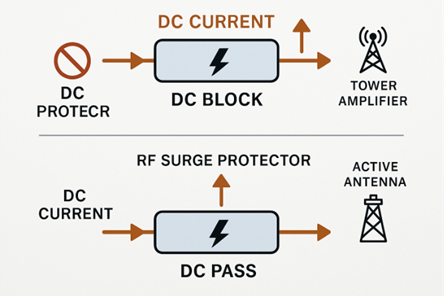
RF surge protectors come in two main styles: DC block and DC pass. A DC block unit stops DC power from traveling through the coax, making it perfect for standard RF connections that don’t power remote devices. DC pass protectors let DC power flow while still safeguarding the line from surges, which is ideal for systems that feed power to tower amplifiers or active antennas. Simply put, use DC pass when your equipment needs power over the coax; use DC block when it doesn’t, for the cleanest signal path.
Another essential characteristic is ultra-low passive intermodulation (PIM), especially in modern networks that use carrier aggregation. Low PIM ensures minimal self-interference within the system, critical for maintaining data throughput and signal clarity.
Physical durability also matters. Outdoor or tower-mounted equipment should use protectors with an IP67 rating to withstand harsh environmental conditions including rain, dust and extreme temperatures. Compatibility is key as well. To ensure seamless integration into any installation, protectors should be available in a wide range of connector types, such as type-N, SMA, 7/16 DIN, 4.3-10, TNC, UHF and type-F.
Importance of Surge Protection
Without proper surge protection, system reliability suffers, and so does the organization’s ability to maintain consistent, mission-critical communications. In public safety or LMR systems, for instance, degraded communication can lead to intermittent or complete signal loss during emergencies. At tower sites, unmitigated surges may trigger widespread network outages, impacting thousands of users and requiring time-intensive diagnostics.
Surges are an invisible but ever-present threat. They don't just fry equipment, they wear it down, degrade performance and silently sabotage signal quality. And RF systems demand specialized solutions that can handle frequency-specific needs without compromise. With patents in DC block, DC pass and ultra-low-PIM RF filter technologies, PolyPhaser has the RF surge protection solutions you need to protect your equipment now and avoid expensive failures later.