Understanding Fiber Multiplexers, Fiber Attenuators, Fiber Splitters, Fiber TAPs and Fiber Terminators
Passive fiber optic components have advantages over active fiber optic devices. Because passive fiber devices do not require AC or DC power, they are less complex, with few or no moving parts or components that fail over time. Thus, they are more reliable and require no regular maintenance. Also, passive fiber devices generally cost less than active fiber devices – not only upfront but for installation and upkeep.
Below we describe the main functions and features of each of PolyPhaser’s five categories of passive fiber optic devices: fiber multiplexers, fiber attenuators, fiber splitters, fiber TAPs and fiber terminators.
Key Takeaways
- Passive fiber optic devices operate without electrical power, making them highly reliable and resilient.
- The absence of active electronics eliminates risks related to power failure, overheating, and electronic noise.
- Components such as splitters, couplers, attenuators, and WDMs form the backbone of passive optical networks.
- Passive devices require minimal maintenance and often outlast active network equipment.
- They are ideal for telecom, FTTx, data centers, and industrial fiber deployments where uptime is critical.
- Simplicity in design directly contributes to lower total cost of ownership and long-term network stability.
What Are Passive Fiber Optic Devices?
Passive fiber optic devices are components used in fiber-optic systems that function without electronic power. They rely on the physical properties of light and optical materials to operate, which means they have no moving parts, no power supply requirements, and very limited failure modes. Common types of passive optical devices include:
- Optical splitters and couplers to divide or combine optical signals.
- Wavelength division multiplexers (WDMs) are used to carry multiple wavelengths over the same fiber.
Because these devices don’t contain active electronics, they avoid the complications of thermal management, electronic noise, and power failures a key parts of their lasting reliability.
Passive Fiber Multiplexers
Wavelength division multiplexing (WDM) is a fiber optic transmission and filtering technique that combines many different wavelength signals onto a single fiber. The main differences between coarse wavelength division multiplexing (CWDM) and dense wavelength division multiplexing (DWDM) are that CWDM carries fewer and wider wavelengths, and the wavelengths are spaced farther apart. This results in CWDM working best at shorter distances (typically up to 50 miles) and lower capacities (typically up to 10 Gbps using Ethernet and up to 16 Gbps using Fibre Channel).
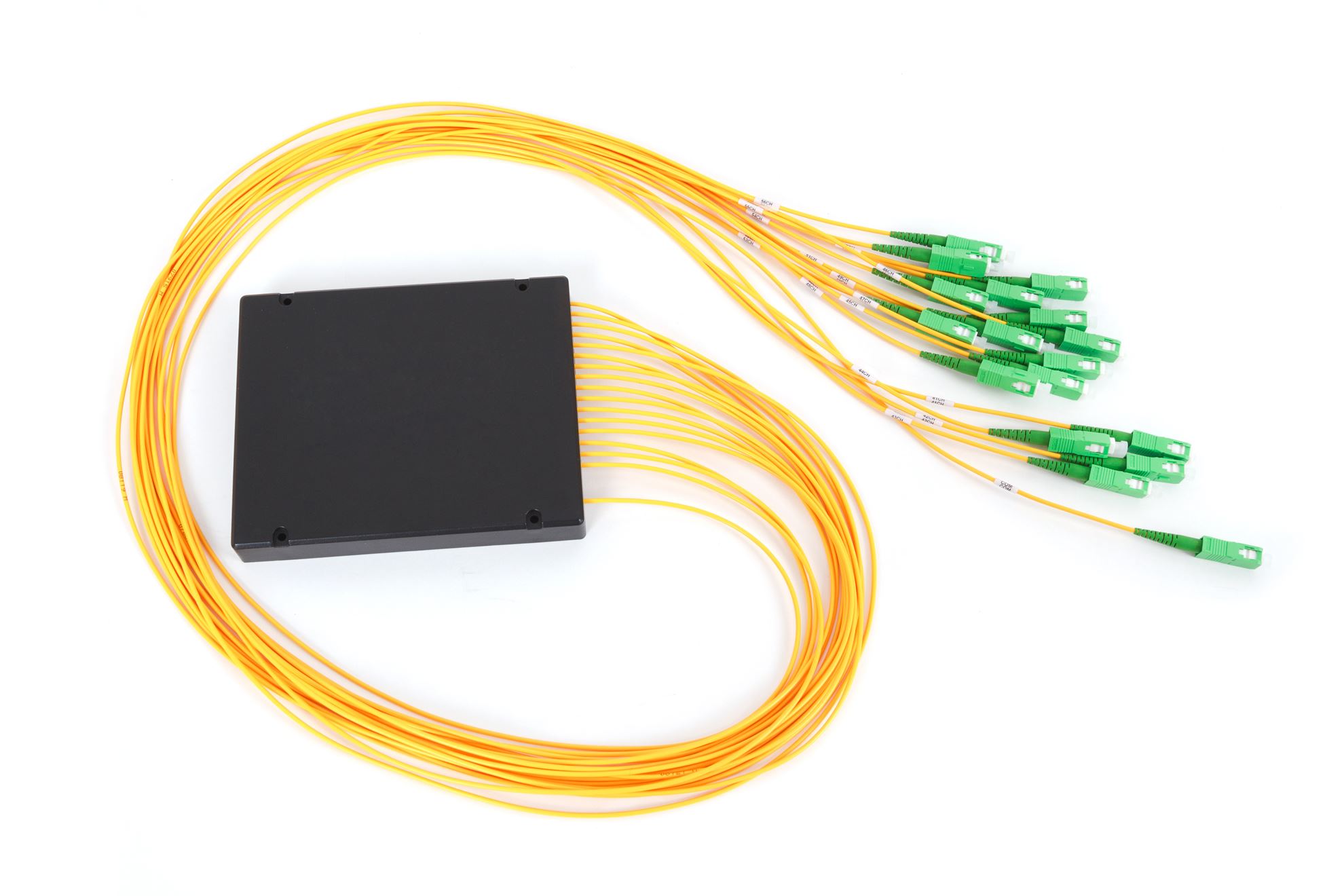
PolyPhaser offers full lines of passive CWDM multiplexers and DWDM multiplexers. They perform multiplexing and demultiplexing (mux, demux), and some models execute both functions at once (mux/demux). We offer options of 4 to 40 channels for indoor, outdoor and industrial use.
Passive Fiber Attenuators
A fiber optic attenuator is a passive device that connects to an optical signal chain and reduces the power of the signal. Usually it is installed when the signal is too powerful for the receiver, perhaps due to a mismatched transmitter and receiver. Each fiber attenuator reduces power by a set amount – PolyPhaser offers models with 1 to 20 decibels of attenuation.
Attenuators come with many fiber connector types. Our bulkhead fiber attenuators attach to one end of a fiber optic cable with different combinations of LC, SC, APC and UPC connectors. They all support single-mode fiber in a wavelength spectrum from 1310 nm to 1550 nm. Our inline fiber attenuators have SC connectors and work with single-mode fiber at wavelengths of either 1310 nm or 1550 nm.
Passive Fiber Splitters
A passive optical splitter allows you to either separate or combine optical signals. For instance, it can receive one signal at a central office and split it into multiple signals to be sent to different locations. It is bidirectional so it can also receive multiple signals and combine them into one. A PLC splitter is so called because it uses “planar lightwave circuit” technology, combining a smaller size with more reliability and less signal loss than non-PLC.
PolyPhaser’s passive PLC optical splitters include options for splitting one input signal into up to 32 output signals, or up to 32 inputs into one output. They are versatile enough to work well with the wide range of broadband network options used in FTTx applications, and are dependable enough to meet the demands of a passive optical network (PON) in a commercial environment.
Passive Fiber TAPs
A special type of splitter is an optical test access point, or a TAP. It allows you to tap into your fiber optic cable to monitor and analyze traffic. Fiber tapping helps you spot and correct data flow performance issues and to ensure that your network is secure. Unlike an active fiber optic TAP, a passive fiber TAP requires no electrical components that might break down or need maintenance.
A fiber optic TAP receives the signal and passes a portion of it to your end device and the remaining portion to your monitor. The two portion amounts are expressed as a split ratio. A 50/50 split ratio means 50% goes to the end device and 50% to the monitor. Other split ratios PolyPhaser offers are 60/40, 70/30, 80/20, 90/10 and 98/2. The ratio you choose will be based on your testing requirements.
Passive Fiber Terminators
If you have an unused port in your fiber optic system, you should close it off with an optical line terminator. This inexpensive device prevents unwanted light from reflecting back into your system, which can cause return loss. PolyPhaser offers optical line terminators with connectors in LC/UPC and SC/UPC configurations.
Check out our entire line of fiber optic passive devices or contact us if you have any questions. We have a huge inventory of in-stock products and offer same-day shipping to keep you up and running.
FAQs (Frequently Asked Questions)
1: What are passive fiber optic devices?
A: Passive fiber optic devices are components that manipulate optical signals without requiring electrical power. They rely solely on optical properties to function.
2: Why are passive fiber devices more reliable than active components?
A: Because they contain no powered electronics, passive devices are not affected by power outages, voltage fluctuations, or heat-related failures.
3. What are common examples of passive fiber optic components?
A: Common passive devices include optical splitters, couplers, attenuators, wavelength division multiplexers (WDMs), connectors, and adapters.
4. Do passive fiber devices affect signal quality?
A: High-quality passive components are designed to minimize insertion loss and reflections, helping maintain strong signal integrity across the network.