
Lightning strikes in the United States about 20 million times a year. That’s not exactly good news for those who operate costly cell phone towers, antenna systems and other wireless communications.
Key Takeaways
- SMA, 2.92 mm, and 3.5 mm connectors may be mechanically compatible, but electrical performance varies significantly.
- When connectors are mated, the system is always limited by the lowest-rated connector.
- 2.92 mm and 3.5 mm connectors are fully compatible and preferred for high-frequency applications.
- Repeatedly mating SMA connectors with precision connectors can cause premature wear and degraded VSWR.
- Using precision adapters helps protect expensive test equipment and improve measurement repeatability.
- Proper torque, alignment, and handling are critical for maintaining connector integrity above 18 GHz.
Why Connector Mating Rules Matter at High Frequencies
At high frequencies, even minor mechanical imperfections in RF connectors can cause significant electrical performance issues. Connector mating rules exist to ensure proper alignment of the center conductors, consistent impedance, and minimal signal reflections. As frequency increases, wavelengths become shorter, making RF systems far more sensitive to gaps, misalignment, or damage at the connector interface. Ignoring proper mating practices can result in higher VSWR, increased insertion loss, unstable measurements, and long-term damage to precision connectors, especially above 18 GHz, where tolerances are extremely tight.
Which Connectors Can Be Safely Mated Together
SMA, 2.92 mm, and 3.5 mm connectors share similar thread dimensions, which allows them to be physically mated. However, not all pairings are equally safe or recommended. The most compatible combination is 2.92 mm to 3.5 mm, as both are precision air-dielectric connectors designed for high-frequency performance. SMA connectors can be mated with either 2.92 mm or 3.5 mm connectors, but performance will be limited to the SMA’s lower frequency rating, and repeated mating can wear out the precision connector. For best results, especially in lab or production environments, precision adapters should be used instead of direct mixed mating.
Risks of Improper or Mixed Connector Mating
Improper mating can lead to both immediate and long-term issues in RF systems. Mechanically, mismatched connectors can damage the center pin, deform the dielectric, or create metal debris that compromises signal integrity. Electrically, this results in higher VSWR, signal reflections, unpredictable phase behavior, and degraded repeatability in measurements. Over time, repeated improper mating accelerates connector wear, often making expensive precision connectors unusable. In high-power or millimeter-wave applications, these risks increase significantly and can lead to costly equipment downtime.
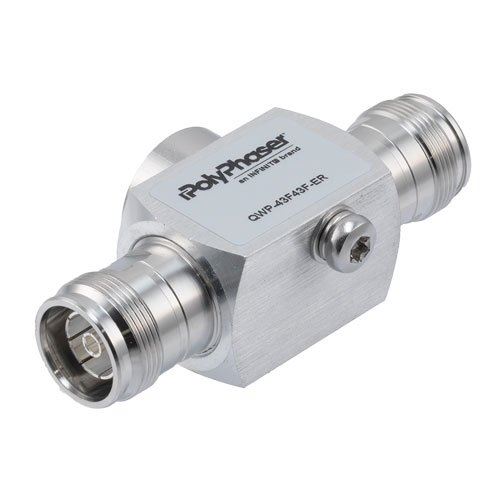
But there is a strong defense against lightning strikes and other causes of extreme power surges. Many companies are deploying coaxial RF quarter-wave stub surge protectors, also known as lightning surge protectors, arrestors or suppressors. They stop surges faster than other types of protectors, require no maintenance and can withstand repeated surges without being damaged.
How They Work
A quarter-wave stub surge protector guards your radio and antenna installations from electromagnetic pulse (EMP) or power surges that are commonly caused by lightning or other strong electrical charges. It is a gatekeeper of sorts, allowing higher frequencies to flow through but instantly diverting harmful lower frequencies, such as lightning strikes, to a ground. The band of frequencies a quarter-wave stub allows to pass through is specified. For instance, PolyPhaser’s models allow either 800 MHz to 2.25 GHz or a wider 555 MHz to 4 GHz.
Applications
The applications of quarter-wave stub surge protectors include:
- Citizens Broadband Radio Service (CBRS) networks
- Cellular phone networks
- Distributed antenna systems (DAS)
- Land mobile radio (LMR)
- Emergency response systems
- Public safety systems
Advantages over Other Surge Protectors
Quarter-wave coaxial RF surge protectors have three big advantages over other types of protectors:
Quick response. A gas discharge tube takes about 100 nanoseconds to become conductive when a surge hits, while a quarter-wave coaxial protector responds instantly. It’s all in the design. The stub that shorts the surge is one-fourth the length of the working frequency of the signal in the cable. Also, the quarter-wave stub protector is made of instantly conductive metal.
No maintenance. A gas discharge tube surge protector occasionally needs a tube replacement, requiring money and time to install. A quarter-wave stub surge protector needs no maintenance after it is installed.
Longer product life. While a single surge from a cell tower might destroy a gas discharge tube, a quarter-wave stub surge protector is a mechanical device that can withstand many surges with no damage.
PolyPhaser’s Quarter-Wave Stub Surge Protectors
PolyPhaser offers a line of quarter-wave stub protectors that share key features:
- Protect sensitive radio and antenna installations where some or all the equipment is outdoors.
- Offer excellent broadband performance, passing 800 MHz to 2.25 GHz or 555 MHz to 4 GHz.
- Have low PIM of −150 dBc, which enables stronger signals and less frequency mixing.
- Offer connector options of 4.3 to 10, 7/16 DIN, and N.
- Use a DC block to suppress DC surge.
- Have bi-directional, repetitive strike surge protection.
- Are RoHS compliant.
- Are in-stock and will ship the SAME DAY as purchased!
Contact us for more information on PolyPhaser’s coaxial RF quarter-wave stub surge protectors.
Best Practices to Protect Precision RF Connectors
Protecting precision RF connectors starts with using the right mating combinations and avoiding unnecessary mixed mating. Always use precision adapters to interface between SMA and higher-grade connectors. Apply the manufacturer-recommended torque using a calibrated torque wrench to prevent over-tightening. Keep connectors clean and capped when not in use to prevent contamination. In test environments, use sacrificial adapters or port savers to protect sensitive instrument ports from repeated wear. Following these best practices extends connector life, maintains RF performance, and ensures consistent, reliable system operation.
FAQs (Frequently Asked Questions)
Q1: Can SMA, 2.92 mm, and 3.5 mm connectors be mated together?
A: Yes, they can be physically mated, but performance is limited by the least precise connector. For high-frequency or repeat-use applications, adapters are recommended.
Q2: Which connector combination offers the best performance?
A: Mating 2.92 mm to 3.5 mm connectors delivers the most reliable high-frequency performance with minimal degradation.
Q3: Why is SMA not ideal for repeated mating with precision connectors?
A: Standard SMA connectors have wider manufacturing tolerances, which can damage the tighter air-dielectric structure of 2.92 mm and 3.5 mm connectors over time.