
Global positioning systems are an important part of
Key Takeaways
- GPS receivers are susceptible to transient voltages caused by lightning, ESD, and switching surges.
- Gas discharge tubes (GDTs) remain non-conductive during normal operation and activate only during surge events.
- GDT-based surge protectors offer low insertion loss, excellent RF performance, and high surge current handling.
- Proper grounding and placement are just as important as the surge protector itself.
- Gas tube protectors are widely used in telecom timing systems, outdoor GPS antennas, and critical RF infrastructure.
What Is a Gas Discharge Tube (GDT) and How It Works
A gas discharge tube (GDT) is a surge protection device designed to safeguard sensitive RF and GPS equipment from high-voltage transients such as lightning strikes, electrostatic discharge (ESD), and power surges. Under normal operating conditions, a GDT remains electrically non-conductive, allowing RF signals to pass through the system without interference. When a sudden voltage spike exceeds the tube’s breakdown threshold, the gas inside the tube ionizes and becomes conductive, creating a low-impedance path that safely diverts excess energy to ground. Once the surge subsides, the gas de-ionizes, and the GDT automatically resets, ready to protect against future events without requiring replacement.
Why Gas Tubes Are Ideal for GPS and High-Frequency RF Protection
Gas tubes are particularly well-suited for GPS and high-frequency RF applications because they combine robust surge handling with excellent signal integrity. GPS signals are extremely low in power and highly susceptible to distortion, so any protection device must introduce minimal insertion loss and maintain stable impedance. GDTs meet these requirements by remaining effectively invisible to the RF path until a surge occurs. They also offer high surge current capability, long service life, and stable performance across wide temperature ranges, making them ideal for outdoor antennas, base stations, timing systems, and mission-critical RF infrastructure.
Installation Best Practices for GPS Surge Protection
Proper installation is critical to achieving effective GPS surge protection. The surge protector should be installed as close as possible to the point where the coaxial cable enters the building or near the GPS receiver itself, minimizing the length of unprotected cable. A low-impedance, short grounding path is essential, as poor grounding can significantly reduce the effectiveness of the gas tube. All connectors should be properly torqued and matched to avoid reflections or signal loss. In outdoor or tower-mounted applications, weatherproof or IP-rated enclosures should be used to protect the device from moisture, dust, and corrosion, ensuring long-term reliability.
RF lighting arrestors come in many forms and use different technologies to provide protection. A circuit protection component, such as a gas tube or diode, are often used in
Figure 1:
A gas tube is a popular protection device that is used in an RF lightning arrestor. A gas tube activates when the gas inside it ionizes and conducts. The drawback
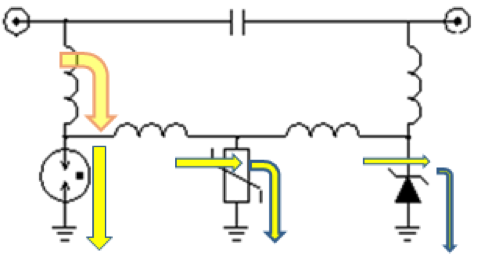
Other RF lightning arrestors will incorporate the gas tube as well as other circuit protection devices. For example, the circuit in Figure 2 outlines a hybrid circuit. This circuit does use a gas
When looking for the highest levels of protection, using a hybrid protector is the best option available for GPS receivers. Gas tube based RF arrestors, though inexpensive, over the least amount of protection against lightning.
Recommendations for Selecting the Right Gas Tube Protector
When choosing a gas tube protector for GPS or high-frequency RF systems, it is important to verify that the device supports the required GPS frequency bands without degrading performance. The protector should have low insertion loss, low VSWR, and sufficient surge current rating for the installation environment. Connector compatibility with existing cables and equipment is also critical to avoid impedance mismatches. For active GPS antennas, selecting a model that supports DC pass-through is essential. Finally, in high-risk or mission-critical applications, gas tube protectors should be integrated into a layered surge protection strategy that includes proper grounding and additional protective components.